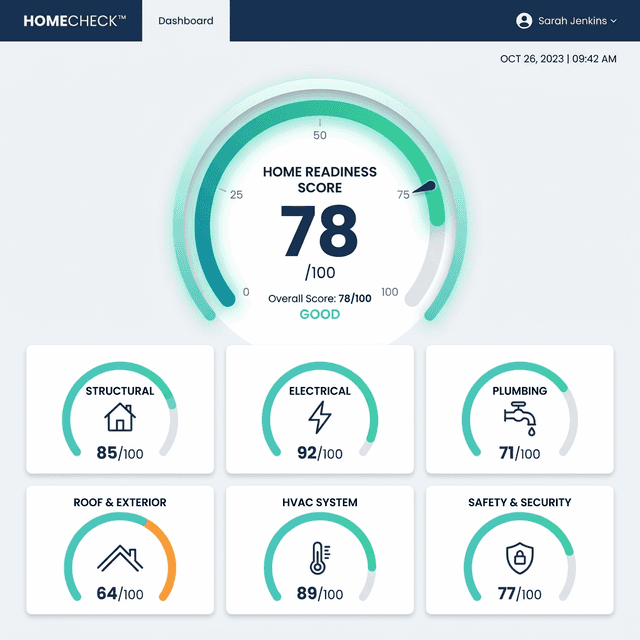
TL;DR: Your Home Readiness Score is a 0–100 composite metric that measures how well your home is documented, maintained, protected, and prepared across six dimensions. Think of it as a credit score for your home. The six dimensions are: Maintenance Compliance (25%), Asset Documentation (20%), Financial Protection (20%), Warranty Coverage (15%), Emergency Preparedness (10%), and Document Organization (10%). The average homeowner starts at 35–45. This guide breaks down exactly how each dimension is calculated and how to improve each one.
Table of Contents
- Why a Composite Score Matters
- The 6 Dimensions and Their Weights
- Dimension 1: Maintenance Compliance (25%)
- Dimension 2: Asset Documentation (20%)
- Dimension 3: Financial Protection (20%)
- Dimension 4: Warranty Coverage (15%)
- Dimension 5: Emergency Preparedness (10%)
- Dimension 6: Document Organization (10%)
- Score Ranges: What Your Number Means
- 5 Quick Wins to Boost Your Score This Week
- FAQ: Home Readiness Score Calculation
Why a Composite Score Matters
Most homeowners manage their property by feel. "The house seems fine." "Nothing is broken." "We'll deal with it later." That intuition fails because home management is multidimensional. You might be excellent at maintenance but terrible at documentation. You might have every appliance cataloged but zero emergency preparedness. A single-metric score that ignores dimensions creates false confidence.
The Home Readiness Score solves this by measuring six distinct dimensions of home health, weighting them by impact, and combining them into a single 0–100 number. Each dimension represents a category where underperformance creates measurable financial risk: insurance claim shortfalls, warranty-covered repairs paid out of pocket, emergency costs that preventive maintenance would have prevented, and property value erosion at sale.
The composite approach has a direct analog in personal finance. Your credit score is not just your payment history — it weighs payment history (35%), credit utilization (30%), length of credit history (15%), credit mix (10%), and new credit inquiries (10%). Similarly, your Home Readiness Score weights the dimensions that have the greatest impact on your financial exposure.
The 6 Dimensions and Their Weights
| Dimension | Weight | What It Measures |
|---|---|---|
| Maintenance Compliance | 25% | Are scheduled maintenance tasks being completed on time? |
| Asset Documentation | 20% | Are your home's assets cataloged with photos, serial numbers, and details? |
| Financial Protection | 20% | Is your insurance coverage adequate? Are your financial records current? |
| Warranty Coverage | 15% | Are active warranties tracked? Are you using coverage before it expires? |
| Emergency Preparedness | 10% | Do you have emergency plans, contacts, and shutoff knowledge? |
| Document Organization | 10% | Are critical home documents digitized, organized, and accessible? |
The weights reflect financial impact. Maintenance Compliance carries the highest weight (25%) because deferred maintenance costs 4–7x more than preventive maintenance. Asset Documentation and Financial Protection each carry 20% because they directly determine insurance claim recovery — undocumented homeowners recover 40–60% of losses versus 85–95% for documented ones.
Dimension 1: Maintenance Compliance (25%)
Maintenance Compliance measures the percentage of manufacturer-recommended and seasonal maintenance tasks completed on schedule. It is the single most impactful dimension because it directly prevents the largest category of avoidable home expenses.
How It Is Calculated
ConductorIQ generates a personalized maintenance schedule based on your actual home systems (from your asset inventory). Each task has a due date. Your Maintenance Compliance score is the ratio of completed tasks to total due tasks, adjusted for urgency.
Formula: (Completed tasks / Total due tasks) × 100, with urgency modifiers:
- Overdue P0 tasks (HVAC, roof, plumbing): -5 points each
- Overdue P1 tasks (filters, caulking, testing): -2 points each
- Overdue P2 tasks (cosmetic, non-critical): -1 point each
Score Interpretation
| Score | Meaning |
|---|---|
| 90–100 | All maintenance current. Equipment running at manufacturer specs. |
| 70–89 | Minor tasks overdue. No critical system risks. |
| 50–69 | Multiple tasks overdue. Cascade risk increasing. |
| Below 50 | Significant backlog. Emergency repair probability is elevated. |
How to Improve
Complete overdue tasks in priority order: HVAC, roof, plumbing, then electrical. Each completed task immediately updates your score. For a seasonal starting point, see our Spring Maintenance Checklist 2026.
Dimension 2: Asset Documentation (20%)
Asset Documentation measures how completely your home's physical assets are cataloged. A fully documented home has every appliance, system, and valuable item recorded with make, model, serial number, purchase date, purchase price, and at least one photo.
How It Is Calculated
ConductorIQ tracks the completeness of each asset profile. A "complete" profile has all essential fields populated. A "partial" profile has some fields. An "undocumented" asset is one that should be tracked but is not in the system.
Formula: (Complete profiles × 1.0 + Partial profiles × 0.5) / Expected total assets × 100
"Expected total assets" is estimated based on your home's size, age, and type. A 3-bedroom single-family home built in 2010 has an expected 35–50 trackable assets. A 5-bedroom home built in 1985 has 50–75.
Score Interpretation
| Score | Meaning |
|---|---|
| 90–100 | Near-complete documentation. Insurance claim recovery potential: 85–95%. |
| 70–89 | Most major assets documented. Minor gaps in secondary items. |
| 50–69 | Major assets documented, but missing detail (serial numbers, receipts). |
| Below 50 | Significant documentation gaps. Insurance claim recovery at risk. |
How to Improve
The fastest improvement comes from ConductorIQ's AI Asset Scanner. Photograph each major appliance — the AI extracts make, model, serial number, and warranty data automatically. A full-home scan takes 20–30 minutes and can boost this dimension by 30–40 points.
ConductorIQ's AI builds your asset inventory from photos. One scan. Complete profiles. Try it free.
Dimension 3: Financial Protection (20%)
Financial Protection measures whether your insurance coverage, financial reserves, and credit/reward tracking are adequate to protect against loss. It ensures you are not just maintaining your home — you are financially prepared for the unexpected.
How It Is Calculated
This dimension evaluates three sub-factors:
Insurance adequacy (50% of dimension): Is your homeowner's policy coverage limit at or above your total asset value? ConductorIQ compares your documented asset inventory total against your stated policy limits. Underinsured homes lose points proportionally to the coverage gap.
Financial record currency (30% of dimension): Are your insurance documents, mortgage records, and property tax records uploaded and current? Outdated or missing financial documents reduce your score.
Credit and reward tracking (20% of dimension): Are you tracking gift cards, store credits, cashback rewards, and credits hiding in your email? Untracked financial value counts against this sub-factor.
Score Interpretation
| Score | Meaning |
|---|---|
| 90–100 | Fully insured, documents current, credits tracked. Maximum financial protection. |
| 70–89 | Adequate coverage with minor gaps. Some credits untracked. |
| 50–69 | Potential underinsurance or significant untracked value. |
| Below 50 | Coverage gaps, outdated records, or major untracked financial exposure. |
How to Improve
Upload your current homeowner's insurance declaration page. ConductorIQ compares your coverage limits against your asset inventory. If underinsured, it flags the gap and recommends a coverage adjustment conversation with your agent. Activate The Vault to scan for untracked credits.
Dimension 4: Warranty Coverage (15%)
Warranty Coverage measures how well you are leveraging manufacturer and extended warranties. The goal is zero out-of-pocket repairs on items that are still covered. Homeowners who track warranties save an average of $340 per year in repairs they would have otherwise paid for.
How It Is Calculated
ConductorIQ tracks the warranty status of every asset in your inventory. This dimension measures:
Coverage awareness (50% of dimension): What percentage of your assets have warranty information recorded (start date, end date, coverage terms)?
Active coverage utilization (30% of dimension): When a repair is needed on a covered item, was the warranty used? Missed warranty claims reduce this score.
Expiration alerting (20% of dimension): Are you receiving alerts before warranties expire so you can address any issues while still covered?
Score Interpretation
| Score | Meaning |
|---|---|
| 90–100 | All warranties tracked. Alerts active. No missed claims. |
| 70–89 | Most warranties tracked. Minor gaps in older items. |
| 50–69 | Major appliance warranties tracked, but many items missing. |
| Below 50 | Warranty data largely untracked. High risk of paying for covered repairs. |
How to Improve
For every item in your asset inventory, verify the warranty status. ConductorIQ auto-populates warranty data from manufacturer databases when you scan an item. For credit card purchase protection, check if your card offers extended warranty coverage (Amex, Chase Sapphire, and Citi all offer this). For more detail, see our guide on how to track home warranties.
Dimension 5: Emergency Preparedness (10%)
Emergency Preparedness measures your readiness to respond to home emergencies — not just natural disasters, but everyday crises like burst pipes, power outages, gas leaks, and HVAC failures. Preparedness is weighted lower (10%) because it is less financially impactful day-to-day, but critical during acute events.
How It Is Calculated
This dimension evaluates the presence and completeness of:
- Emergency shutoff knowledge: Do you know where your main water shutoff, gas shutoff, and electrical panel are? Are they documented with locations and photos?
- Emergency contacts: Do you have plumber, electrician, HVAC, and general contractor contacts saved and accessible to all household members?
- Insurance contact readiness: Can you reach your insurance agent and file a claim within minutes of an emergency?
- Backup power and supplies: Do you have a plan for extended power outages?
How to Improve
Document your shutoff locations with photos (ConductorIQ has a dedicated section for this). Add at least four emergency contractor contacts. Upload your insurance agent's contact information. These steps take 15 minutes and typically boost this dimension by 30–50 points.
Dimension 6: Document Organization (10%)
Document Organization measures whether critical home documents are digitized, categorized, and accessible. This includes property records (deed, title, survey), financial records (mortgage, tax assessments), insurance policies, contractor agreements, permits, and HOA documents.
How It Is Calculated
ConductorIQ uses a checklist of expected documents based on your property type and ownership status. Each uploaded and categorized document earns points. Missing documents lose points proportionally to their importance.
Critical documents (higher weight): Deed/title, insurance policy, mortgage note, property survey, HOA covenants.
Important documents (medium weight): Tax records, utility records, contractor agreements, permits, inspection reports.
Supporting documents (lower weight): Appliance manuals, paint colors, renovation plans, vendor receipts.
How to Improve
Start with the critical documents. If you closed on your home within the last 5 years, your closing documents folder contains most of them. Upload your deed, insurance declaration page, mortgage statement, and property survey. ConductorIQ's document scanner uses OCR to extract key data (property address, policy numbers, coverage limits) and auto-categorizes each upload.
Score Ranges: What Your Number Means
| Score Range | Rating | What It Means | Action Level |
|---|---|---|---|
| 90–100 | Excellent | Top 5% of homeowners. Fully documented, maintained, and protected. | Maintain current practices. |
| 80–89 | Very Good | Minor optimization opportunities. No significant exposure. | Address flagged items quarterly. |
| 70–79 | Good | Above average, but gaps exist in 1–2 dimensions. | Focus on weakest dimension this month. |
| 60–69 | Fair | Multiple dimensions below target. Financial risk is present. | Create 30-day improvement plan. |
| 50–59 | Below Average | Significant gaps. Insurance claims and emergency costs are likely higher than necessary. | Prioritize asset documentation and maintenance. |
| Below 50 | Critical | Major exposure across most dimensions. Immediate action recommended. | Start with AI home scan and insurance review. |
The average ConductorIQ user starts at 35–45. That is not unusual — most people have never systematically documented or tracked their home. Within 90 days of active use, the average user reaches 70+. The documentation-heavy dimensions (Asset Documentation, Financial Protection, Document Organization) improve fastest because they require data entry, not physical maintenance.
5 Quick Wins to Boost Your Score This Week
These five actions take less than 2 hours total and produce the largest score improvements:
1. Scan your top 10 assets (30 minutes, +15–25 points to Asset Documentation): Use ConductorIQ's AI scanner on your HVAC, water heater, refrigerator, washer, dryer, dishwasher, range, microwave, garage door opener, and electrical panel. Ten scans. Ten complete profiles.
2. Upload your insurance declaration page (5 minutes, +10–15 points to Financial Protection): Your insurance company emails this annually. Search "declaration page" or "policy renewal" in your inbox.
3. Document your shutoff locations (15 minutes, +20–30 points to Emergency Preparedness): Take photos of your water shutoff valve, gas shutoff valve, and electrical panel. Label them in ConductorIQ.
4. Upload your deed and mortgage statement (10 minutes, +10–15 points to Document Organization): These are likely in your closing documents folder or available from your lender's portal.
5. Complete one overdue maintenance task (varies, +5–10 points to Maintenance Compliance): Replace HVAC filters, test smoke detectors, or check water heater temperature. Quick wins that prove the system works.
Total estimated improvement: 60–95 points worth of dimension boosts, resulting in a 25–35 point overall score increase.
FAQ: Home Readiness Score Calculation
What is a good Home Readiness Score?
A Home Readiness Score of 80–100 is considered excellent — your home is well-documented, well-maintained, and financially protected. Scores of 60–79 are good but have clear improvement areas. Scores of 40–59 indicate significant gaps that expose you to financial risk. Below 40 means critical areas need immediate attention. The average ConductorIQ user starts at 35–45 and reaches 70+ within 90 days.
How is the Home Readiness Score calculated?
The Home Readiness Score is a weighted composite of six dimensions: Maintenance Compliance (25%), Asset Documentation (20%), Financial Protection (20%), Warranty Coverage (15%), Emergency Preparedness (10%), and Document Organization (10%). Each dimension is scored 0–100 based on specific measurable criteria, then combined using the weighted formula to produce your overall 0–100 score.
How can I improve my Home Readiness Score quickly?
The fastest ways to improve your Home Readiness Score are: complete your home asset inventory with AI scanning (boosts Asset Documentation by 30–40 points), upload insurance and warranty documents (boosts Financial Protection and Warranty Coverage by 20–30 points), and complete overdue maintenance tasks (boosts Maintenance Compliance immediately). Most users gain 25–35 points in the first week by focusing on documentation.
Find out where your home stands. ConductorIQ calculates your Home Readiness Score automatically as you document your property — with specific recommendations to improve each dimension.